I took this class because I wanted to learn more about patents because I hope to own one of my own someday. I didn't know that there were various elements that go into making a patent, and the process that goes into getting it approved.
I particularly liked the subjects of obviousness and prior art in this class. Having homework assignments specifically related to these topics also helped reinforce the material in my mind. Additionally, I liked how we focused mostly on patent cases relating specifically to smartphones (like Apple vs Samsung lawsuits).
I'm an aspiring entrepreneur, and the knowledge I gained from this class will definitely be very useful for me in the future when launching products and such. I really enjoyed this class, and I will definitely encourage other students to take it in the future.
Throughout the semester, we used social media exclusively to complete our homework assignments. I particularly liked this because it is very different from most classes that I have taken. It forced us to get out of our comfort zones and talk in front of a camera about topics, with our own input as well.
The YouTube videos improved my speaking abilities and how I organize my thoughts. It's like giving mini speeches but in front of a camera. I liked how they were supposed to be short and succinct, because that is a good rule of thumb for giving speeches in life.Commenting on others blog posts and videos also allowed us to learn from each other by forcing us to read other peoples' findings and opinions. Finally, tweeting was a nice small assignment where we could share 1 sentence thoughts with everybody.
Overall, I liked the use of social media in this course, and definitely think it should be continued in future years.
In March 2015, Microsoft alleged that the Japanese tech company, Kyocera, infringed on patents related to cell phones. In addition to seeking damages, the Washington-based tech firm sought a ban on U.S. sales of Kyocera products, including its Hydro, Duraforce, and Brigadier lines.
Microsoft named seven patents related to a number of mobile device patents -- relating to text messaging, battery life, motion sensing, location sensing, and power savings. These all relate to devices that can sense changes in the user's environment and linking computers and mobile devices.
Kyocera's phones run on Google's Android operating system, and Microsoft established a licensing agreement with Google, earning a good amount of revenue from its patents that are used in the operating system.
However, in July 2015, the two companies came to a resolution suit and simultaneously signed an expanded patent-licensing arrangement. However, more details were not released.
In March 2, 2010, Apple filed suit against HTC, alleging that the company infringed 20 patents "related to the iPhone's user interface, underlying architecture, and hardware." Steve Jobs even released this statement:
We can sit by and watch competitors steal our patented inventions, or we can do something about it. We've decided to do something about it We think competition is healthy, but competitors should create their own original technology, not steal ours.
The 20 patents in litigation were: Patent #7,362,331: Time-Based, Non-Constant Translation Of User Interface Objects Between States Patent #7,479,949: Touch Screen Device, Method, And Graphical User Interface For Determining Commands By Applying Heuristics Patent #7,657,849: Unlocking A Device By Performing Gestures On An Unlock Image Patent #7,469,381: List Scrolling And Document Translation, Scaling, And Rotation On A Touch-Screen Display Patent #5,920,726: System And Method For Managing Power Conditions Within A Digital Camera Device Patent #7,633,076: Automated Response To And Sensing Of User Activity In Portable Devices Patent #5,848,105: GMSK Signal Processors For Improved Communications Capacity And Quality Patent #7,383,453: Conserving Power By Reducing Voltage Supplied To An Instruction-Processing Portion Of A Processor Patent #5,455,599: Object-Oriented Graphic System Patent #6,424,354: Object-Oriented Event Notification System With Listener Registration Of Both Interests And Methods Patent #5,481,721: Method for providing automatic and dynamic translation of object oriented programming language-based message passing into operation system message passing using proxy objects Patents #5,519,867 and #6,275,983:Object Oriented Multitasking System and Object-Oriented Operating System Patent #5,566,337: Method and apparatus for distributing events in an operating system Patent #5,929,852: Encapsulated network entity reference of a network component system Patent 5,946,647: System and method for performing an action on a structure in computer-generated data Patent #5,969,705: Message protocol for controlling a user interface from an inactive application program Patent #6,343,263: Real-time signal processing system for serially transmitted data Patent #5,915,131: Method and apparatus for handling I/O requests utilizing separate programming interfaces to access separate I/O service Patent #RE39,486: Extensible, replaceable network component system Apple filed the lawsuit in the U.S. District Court for the District of Delaware and a complaint against HTC under Section 337 of the Tariff Act of 1930 with the U.S. International Trade Commission in Washington, D.C. Apple even requested the U.S. International Trade Commission to block imports of HTC's patents. The ITC rejected all but one of Apple's claims, ruling for Apple on a single claim related to data tapping. HTC motioned the Delaware court for a change of venue to the Northern District of California, arguing against Apple's desire to consolidate the case with the similar cases brought by Nokia against Apple,[202] alleging insubstantial overlap between those cases and Apple's complaint, but Judge Gregory M. Sleetdenied HTC's motion for a venue change, ruling that Apple's choice of forum would prevail.
Patent 6,718,554 titled "Hands free towel carrying system" was issued in 2003. As you can see from the picture above, this really is just a towel with a neck loop -- almost like a towel-bib. The first two claims are as follows:
1. A hands free towel carrying system for coupling a towel to a user to prevent loss, theft or contamination comprising, combination:
a towel of a generally rectangular configuration comprised of an absorbent material of a color of the user's choosing, having a loose end, a parallel coupling end and a pair of side edges therebetween, the side edges being between about 15 percent and 25 percent greater than the length of the loose and coupling ends, the coupling end being formed from the folding over of a top end and coupling the top end to an intermediate portion of the towel through stitching thereby forming a tunnel in the coupling end, the region of the towel forming the tunnel being shirred with inner regions and outer regions adapted to expand and contract to allow enlargement and reduction of the size of the tunnel;
a neck loop of a generally cylindrical configuration and being comprised of an elastomeric material, the neck loop being adapted to be stretched around a user's head without messing up the user's hair and glasses and being adapted to rest around the user's neck, the neck loop forming a base around which the tunnel of the coupling end of the towel can be formed for enlargement and reduction in size thereby retaining the towel in a convenient enlarged position during donning by the user and reduced configuration during wearing by the user;
a pocket positioned on the towel and having a resealable coupling selected from the class of resealable couplings including snaps, buttons, zippers and hook and loop fasteners, preferably a snap, with the pocket being adapted to hold loose objects the user desires to keep in safe proximity; and indicia positioned on the towel, the indicia being selected from the class of indicia including monograms, advertisement, and sports logos.
2. A hands free towel carrying system comprising: a towel of a generally rectangular configuration comprised of an absorbent material having a loose end, a parallel coupling end formed from the folding over of a top end and coupling the top end to an intermediate portion of the towel through stitching thereby forming a tunnel in the coupling end, the region of the towel forming the tunnel being shirred with inner regions and outer regions adapted to expand and contract to allow enlargement and reduction of the size of the tunnel, and a pair of side edges there between; and a generally cylindrical neck loop comprised of an elastomeric material.
Basically, that was a really convoluted way of saying this is a towel with a neck loop, and a small pocket to keep things in. Since the bib for babies has been around for a while, I really don't see how this is a unique, creative invention. Furthermore, I think this patent is fairly obvious because usually people just let the towel hang around the neck if they wanted a hands-free towel. And that act alone would infringe on, probably, 70% of this patent. I would definitely use this product when shaving my face, but I don't think it warrants an issued patent. That is why I think this patent is pretty "silly".
Patent 7,970,657 has been awarded to Facebook for "giving gifts via a social network and displaying icons representing assets that have been acquired via the social network". There are 52 claims to the patent, but like with most software patents, claim 1 sums up the patent pretty well (the other claims are details):
1. A method for representing ownership of an asset in a social network environment, the method comprising: receiving a request from a first user of the social network environment to purchase the asset for a second user; recording information about a purchase of the asset from a vendor; associating, by a server for the social networking environment, the purchased asset with a profile of the second user; sending for display to a viewing user an association between the purchased asset and the second user on a feed display page; sending for display to the viewing user, in connection with the association between the purchased asset and the second user, information indicating that a third user, with whom the viewing user has established a connection in the social network, owns the asset, and information including a name of the first user who gave the asset to the second user, on the feed display page.
The reason why I think this patent is silly is because this concept is nothing new, nor invented. For example, there have existed online games and communities where you can gift other players certain items or abilities. For example, if Player X gifts player Y 10 gold coins, the game would display "Player X gifted Player Y 10 gold coins!" and that would infringe on this patent. The only real differentiation here is that this patent specifies a "social network", but one could argue that an online game in which a user plays with other real players is also a social network since you can have friends and connections. Because I believe this concept has already existed for many years, I believe this really is a "silly" patent.
In the patent case between Prometheus Laboratories and Roxane Laboratories, the U.S. Court of Appeals for the Federal Circuit upheld the finding from the U.S. District Court for the District of New Jersey of patent invalidity on the basis of obviousness. The contested patent, U.S. Patent No. 6,284,770, is in regards to Prometheus’ medication used to treat irritable bowel syndrome. The medication is called Lotronex. Prometheus sued Roxane on the basis of infringement of multiple claims of the patent. Roxane challenged the validity of the patent under theories of obviousness and obviousness-type double patenting in view of another patent owned by Prometheus and the state of the prior art of treating IBS. The claims in dispute are:
A method for treating a diarrhea-predominantfemale IBS patient,while excluding those with predominant constipation, said method comprising: assessing whether said diarrhea-predominant female IBS patient has experienced symptoms for at least six months; and administering an effective amount of alosetron or a pharmaceutically acceptable derivative thereof to said patient who has experienced symptoms for at least six months, wherein said effective amount is dependent on the condition of the patient and is at the discretion of the attendant physician.
The method for treating according to claim 5, further comprising assessing whether said female IBS patient has experienced at least moderate pain prior to administration of alosetron.
A method for treating a diarrhea-predominantfemale IBS patient, while excluding those with predominant constipation, said method comprising: assessing whether said diarrhea-predominant female IBS patient has experienced symptoms for at least six months; assessing whether said nonconstipated female IBS patient experiences at least moderate base- line pain from IBS; and administering an effective amount of alosetron or a pharmaceutically acceptable derivative thereof to said patient who has experienced symptoms for at least six months and who experiences at least moderate baseline pain from IBS, wherein said effective amount is dependent on the condition of the patient and is at the discretion of the attendant physician.
The court related this case to another case between AbbVie Inc. and Mathilda and Terrence Kennedy Institute of Technology. As a result, it held that
The patent was obvious
Secondary considerations did not support a conclusion that the patent was not obvious
Basically, the court did not find significant differences between the prior art and the limitations mentioned in the patent. As a result, the patent was deemed invalid.
In 2007, Teleflex, Inc. sued KSR international claiming that one of KSR's products infringed Teleflex's patent on connecting an adjustable vehicle control pedal to an electronic throttle control. KSR argued that the combination of the two elements was obvious, and the claim was therefore not patentable. The district court ruled in favor of KSR, but the Court of Appeals for the Federal Circuit reversed it in January 2005. The case then went to the U.S. Supreme Court, where it unanimously reversed the judgment of the Federal Circuit in 2007. It held that the disputed claim 4 of the patent was obvious under the requirements of 35 U.S.C. 103 and that in rejecting the District Court's rulings, the Court of Appeals analyzed the issue in a narrow, rigid manner inconsistent with 103 and the precedents'. When generally describing the obviousness test, the Court was largely controversial:
In determining whether the subject matter of a patent claim is obvious, neither the particular motivation nor the avowed purpose of the patentee controls. What matters is the objective reach of the claim. If the claim extends to what is obvious, it is invalid under §103. One of the ways in which a patent's subject matter can be proved obvious is by noting that there existed at the time of invention a known problem for which there was an obvious solution encompassed by the patent's claims.
The contested patent was Patent No. 6, 237, 565 B1, entitled "Adjustable Pedal Assembly With Electronic Throttle Control". Claim 4 of the patent describes a mechanism for combining an electronic sensor with an adjustable automobile pedal so the pedal's position can be transmitted to a computer that controls the throttle in the vehicle's engine. When Teleflex accused ksr of infringing on this patent by adding an electronic sensor to one of KSR's previously designed pedals, KSR countered that claim 4 was invalid because its subject matter was obvious.
The second unicorn company I'll be talking about is Instacart. To give a brief background of the company, Instacart was founded in 2012 in San Francisco. It is an internet-based grocery delivery service. Users can select items from local grocery stores and a driver will pick them up and deliver them.
Instacart's IP portfolio is extremely small -- it has 0 patents. They seem to be in a unique position in that they're operating in an increasingly on-demand economy, where there are many successful on-demand services like Postmates, Uber, Lyft, SpoonRocket, TaskRabbit, etc. So perhaps the reason their portfolio is so small is because there really isn't anything to patent.
The first competitor is the on-demand food delivery service, Postmates. Postmates started by delivering food from restaurants, but just recently started expanding to grocery stores. However, they actually do not own any patents as well.
The second competitor is TaskRabbit, which is an online freelance labor service, where you can hire people to run errands and do chores. However, the interesting thing is that they also, do not own any patents. There seems to be a correlation between on-demand services and small (or non-existent) IP portfolios.
The third competitor is Envoy, which is another online grocery delivery service. However, they also do not own any patents. Now I can see a clear correlation between small IP portfolios and on-demand delivery services.
My recommendation would have been to patent a specific way of delivering the groceries to the user, but now that I see there are 0 patents held by any of its competitors, I'm not sure if there really is anything that Instacart could patent. Nothing they are doing is really proprietary, unless they could find some unique way to engage their drivers with the users, so they could patent it.'
The first unicorn company I'll be talking about is Nextdoor. I actually have a personal connection to this company, because I interned there Summer 2014 as a software engineer. To give a brief background of the company, Nextdoor was founded in October 2011, and is a private social network application for neighborhoods. It competes with other community-based social networks such as Facebook, Yahoo Groups, Yelp, etc. However, it differentiates itself via a strict privacy policy -- you must verify you live in the neighborhood to join its network.
Nextdoor's IP portfolio is extremely small. Based off a Google Patents search, the company only has 2 patents: "Providing content to a geographically constrained set of recipients", and "Methods and Systems for a location-based online social network".
The first competitor is the social network giant Facebook, which owns over 1,000 patents (mostly through acquisitions). Compared to Nextdoor's, Facebook's IP portfolio is much larger. However, Facebook's product is more generalized in the sense that it is a general social network, whereas Nextdoor is very specific. However, if Facebook continues to grow its IP portfolio rapidly, Nextdoor could find itself infringing on their patents unwittingly in the future.
The second competitor is Yahoo Groups. Yahoo has been one of the first players in the game for online communities. However, with the rise of Facebook, Yahoo Groups' usage saw a decline. Yahoo! Inc. owns thousands of patents (couldn't get an actual number, but the number is definitely in the thousands). Considering they have way more patents than Nextdoor, Nextdoor faces a similar situation with Facebook in that they could unwittingly infringe on Yahoo's patents. In fact, Yahoo actually sued Facebook in 2012 over 10 patents. If Nextdoor gets much larger, which I think it will, then Yahoo could play a similar game with them.
The third competitor is Yelp. Even though Nextdoor is primarily a social network, its eventual goal to monetize seems to be through integrating local businesses and classifieds. The local businesses model is a direct competitor to Yelp, which it focuses its entire business model around. However, Yelp only has one patent (via Google Patents), while Nextdoor holds two. So numbers-wise, Nextdoor is in a better position than Yelp. However, neither of the two patents that Nextdoor holds are about local businesses, so Nextdoor could be seeing some issues down the road in that area.
To bolster its IP portfolio, I think Nextdoor needs to diversify its patent-holdings. Since they don't seem to have the need to acquire other companies, boosting its IP portfolio through acquisitions doesn't make sense. So the only other way to increase its portfolio is by filing the patents themselves. Currently, their holdings are all very technical -- on the engineering side. Diversifying to have patents about the product itself could be beneficial down the road.
In this post, I'll be analyzing one of the claims of one of the patents litigated in the Samsung vs Apple lawsuit. In the case, a panel of appeal judges actually overturned Apple's $120 million victory against Samsung. The case consisted of three patents:
1. 5,946,647 - "System and method for performing an action on a structure in computer-generated data"
2. 8,046,721 - "Unlocking a device by performing gestures on an unlock image"
3. 8,074,172 - "Method, system, and graphical user interface for providing word recommendations"
In this post, I will be focusing on claim #1 in the third patent (8,074,172), which is as follows:
1. A method, comprising:
at a portable electronic device with a touch screen display:
in a first area of the touch screen display, displaying a current character string being input by a user with the keyboard;
in a second area of the touch screen display that is between the first area and the keyboard, displaying the current character string or a portion thereof and a suggested replacement character string for the current character string on opposite sides of the second area;
replacing the current character string in the first area with the suggested replacement character string if the user activates a space bar key on the keyboard;
replacing the current character string in the first area with the suggested replacement character string if the user performs a first gesture on the suggested replacement character string displayed in the second area; and
keeping the current character string in the first area and adding a space if the user performs a second gesture in the second area on the current character string or the portion thereof displayed in the second area.
This claim is all about Apple's revolutionary autocorrect feature, in which the screen will prompt the user for word suggestions when typing on the touchscreen keyboard. In the title of the claim, Apple specifies it can only be used for a touch screen display on a portable electronic device. Under the subpoints, they categorize different areas of the screen in terms of what it will show for its autocorrect feature. In the first point, it says basically that the screen will show the user's typing string in one area. In the second point, it says that there is another area of the screen where it will show the suggested replacement character string for the string that is currently being typed by the user. In the third point, if a user presses space with a suggested replacement character string, then the software will automatically replace the string for you. In the fourth point, if the string will be replaced if there are a series of gestures applied, triggering the autocorrect.
It's cool to see a patent claim for a feature that we all use everyday now. The patent was very easy to read and comprehend, which is something that I believe is crucial for a solid patent these days.
The patent litigation case that I decided to analyze was the Carnegie Mellon University vs Marvell Tech Group case. This case has been going for about 7 years, and resulted in Marvell paying Carnegie Mellon University a settlement of $750 million. This money will eventually go to the the inventors who developed the patents at CMU. This case is centered around 2 patents: 1. 6,201,839 - "Method and Apparatus for Correlation-Sensitive Adaptive Sequence Detection" 2. 6,438,180 - "Soft and Hard Sequence Detection in ISI Memory Channels" In this post, I will be analyzing Claim 4 of the first patent -- "Method and Apparatus for Correlation-Sensitive Adaptive Sequence Detection" (6,201,839). The claim is as follows:
4. A method of determining branch metric values for branches of a trellis for a Viterbi-like detector, comprising:
selecting a branch metric function for each of the branches at a certain time index from a set of signal-dependent branch metric functions; and
applying each of said selected functions to a plurality of signal samples to determine the metric value corresponding to the branch for which the applied branch metric function was selected, wherein each sample corresponds to a different sampling time instant.
5. The method of claim 4 further comprising the step of receiving said signal samples, said signal samples having signal-dependent noise, correlated noise, or both signal-dependent and correlated noise associated therewith.
After reading this claim, it looks like it is focusing on the specific way in branch values are calculated. However, it does specify that this only applies for a Viterbi-like detector. The specific way in which they are calculated are broken down into parts. The first is that there is a specific time in which the branch metric functions are applied. The second is that each function applied for determining the branch metric values must be applied to a plurality of signal samples.
I'm no electrical engineer, but I liked how this claim was somewhat easy for an undergraduate student like myself to understand. I also took away from this that no matter how complicated or dense the subject matter is, it is always a good idea to write it in simple English, such that people can deduce the meaning of the claims from the given material.
A U.S. judge ordered Mars Inc. to produce certain documents for two companies that Mars has accused of infringing on their patents for certain breath freshening dog treats. The two companies are Science Holding LLC and TruRX LLC. Mars must also pay for one-third of attorneys fees for the two companies and certain costs for deposing expert witnesses. This decision looks like an attempt to punish Mars for taking unnecessary action against them, to the companies that are being pursued.This specific claim was first submitted in 2013 and is over two patents. One is called '176 and the other is called '892, both of which pertain to their dog treat products and have been held since 2002 and 2003. According to Mars, the two companies have produced products called "Minties" and "Breathbuster" that infringe on their patents. However, True Science Holding claims that while the products are obviously competitors, there is no patent infringement in this case. Without knowing the technical details of these patents and intellectual property, it will be difficult to determine who's right and who's wrong (I guess that's the job of the judge). But it's amazing to see all these IP cases play out -- some of which are legitimate IP disputes and some of which are just patent trolls looking to make a quick buck. Source: http://www.law360.com/articles/761808/mars-to-hand-over-docs-in-texas-dog-treat-patent-row
Booking.com is an online travel booking website run by Priceline.com. This case revolves around them filing for a trademarking request for their website name “Booking.com”. However, the Appeal Board did not approve of the request, since their name was too generic.
Foley & Lardner LLP represented the branch of Priceline, stating “consumers would no read any dual meaning in the term”. Moreover, the judge found that Booking.com only pertains to the act of booking travel services, contrasting the “wide array of other services” that are otherwise provided by a travel agency.
The court also mentioned that "very strong evidence of acquired distinctiveness would be required to render the term registerable" and could not find "actual market recognition of Booking.com as a source indicator" of gaining users to the platform.
I agree with the court in that the name is too generic to be awarded copyright, however, I am also at crossroad because I believe if they own the domain they should be able to copyright it. This case really exemplifies the ongoing cases of what can be considered intellectual property and what cannot.
On February 2, the U.S. District Court for the Central District of California found that Blueprint was guilty of infringing on a Nomadix patent protecting key technology for redirecting user computers to captive portal pages. The ruling actually came out after the court had previously denied three summary judgement motions filed by Blueprint RF to invalidate Nomadix's patents.
The availability of high speed internet access is a major factor determining consumer satisfaction when staying in hotel or resort lodgings. This is the market Blueprint RF has been meddling with Nomadix's IP territory.
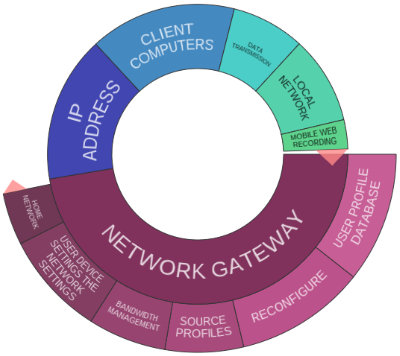
Nomadix’s Internet access gateway technologies allow a business to control public connectivity to their private wireless Internet networks. These gateways are in use in places like hotels, cafes, laundromats or other businesses where WiFi is offered to customers. The company holds more than 100 patents across 15 areas of functionality and has shipped more than 50,000 units across the globe over the past decade. The company holds 51 U.S. patents; as the Innography text cluster here will show readers, most of this intellectual property is focused on network gateways.
A three judge panel on the U.S. Circuit Court of Appeals for the Federal Circuit reversed a verdict from 2014 that initially had Samsung paying more than $2 billion in damages from Samsung for infringing on eight different software patents.
This Friday, the appeals court determined that two of those eight patents should not have been granted initially, and added that Samsung did not infringe on the third patent. Samsung was then awarded $158,400.
This sets a precedent that patent lawsuits may be dying down, and that companies should be more wary when filing patent lawsuits without much premise.
The judges also overturned a verdict that Samsung infringed on Apple's patents for software that automatically converts texts to links, like a phone number.
This is an overall, across-the-board loss for Apple and other tech giants who hope to make quick bucks by suing for intellectual property.
So from my previous post, you know the basics of the Apple vs VirnetX patent lawsuit. In this post, I'm going to try and dig deeper into what this case is fundamentally based on: "patent trolling". Patent trolling is essentially when a company owns many patents and licenses or sues over them. They're usually comprised solely of litigators, since they spend most of their time in court. A patent troll never has the intention of actually creating a product based on their patents -- all their money comes from licensing and lawsuits. Most of the time, the company doesn't create the patents by themselves, but rather buy them from inventors with cash. To me, both sides have their respective arguments. To argue for Apple, I say that this case shows a loophole in our intellectual property system here in the United States -- or even the world. Morally, the purpose of creating a patent is to prove your intellectual work and claim rights to it, so that you can develop a product eventually without a competitor stealing your idea. Additionally, one can argue that other people can build on your patent to further advance society. But VirnetX also has an argument: Apple should have done its due diligence and notice that they were infringing on somebody's patents. Legally, they own the patents and have a right to license it out to others for use. It's really hard to say who's right and who's wrong. But at the end of the day, this suit is chump change for Apple who currently has $234 billion in the bank. https://youtu.be/cTf4WFIqILY
VirnetX is a notorious "patent troll" (a company that makes its money through patent lawsuits without intending to implement the business-side of the patents), that has sued Apple in the past and has done so successfully again for a whopping $625 million. This case was actually filed in 2012 and Apple was forced to pay $368 million in damages. But Apple appealed and the case was sent back down to a court in Eastern Texas, where the new jury actually concluded Apple owed even more than initially.
The lawsuit came down to these patents: Establishment of a secure communication link based on a domain name service (DNS) request US 7490151 B2, Agile network protocol for secure communications using secure domain names US 7418504 B2, Agile network protocol for secure communications with assured system availability US 6502135 B1, and Agile network protocol for secure communications using secure domain names US 7921211 B2. These patents are very technical and beyond the scope of this blog post, but they mostly revolve around Apple's VPN (Virtual Private Network) usage in the iPhone's iMessage and FaceTime services.
Interestingly, this lawsuit was filed in Eastern Texas to a court that is notoriously friendly to patent holders. While I believe VirnetX legally holds the rights to these patents, it's a little discomforting to see that they were sneaky about the lawsuit and tried to cheat the system. https://youtu.be/dBiLbsJGjig
The earliest hints of vaccine practice come from the Chinese via the practice of inoculation for smallpox in the 10th century. A vaccine is a biological preparation that provides active acquired immunity to a particular disease. A vaccine typically contains an agent that resembles a disease-causing micro-organism made from weakened or killed forms of the microbe. Once injected into the person's body, the person's immune system will recognize it as a threat and destroy it, while keeping a record of it so it will destroy any similar micro-organisms later encountered. Vaccination is the most effective method of preventing infectious diseases. Immunity due to vaccination is responsible for the worldwide eradication of smallpox and the restriction of other diseases such as tetanus, measles, and polio from most of the world. Needless to say, vaccines have saved millions of human lives throughout our history. The reason I believe vaccines are the most important invention in human history, is because it could have saved our species from extinction. The thing that separates humans from other animals is our intelligence--and as a species, we have been able to develop a "pre-cure" for diseases. I think that's pretty amazing. In today's world, it's easy to dismiss vaccines as incredibly important and revolutionary, but that's because it has become so engrained in our society because of its importance. For example, we are required to get certain vaccinations at birth, for school, and for work. If somebody does not get a vaccine, they are putting others at harm's way because they can spread disease if not vaccinated. Before vaccines, death by disease was not uncommon. People knew that there was a high chance they could die prematurely due to disease or infection. Sanitary conditions back then were also not great, which only magnified the terrible consequences of disease spreading around. Now, thanks to vaccines, sanitation, and technology, I can live my life without worrying about dying of smallpox and other eradicated diseases. https://www.youtube.com/watch?v=wCHcTfph8-Q
A new week means a smarter me. After reading, watching, and listening to other students' top 10 inventions lists, I realized I missed some key inventions that really shaped how we live today. Without further ado, here it is:
1. Concrete
Walk outside, and think about the material that makes up a lot of our world today. It's not even natural, it's manmade -- concrete. Without concrete and other new manmade materials, we wouldn't have the sidewalks, roads, buildings, bridges, etc. that we have today. Without concrete, we may still have some buildings built out of wood, which could be burnt down from a fire in a breath.
2. Mathematics
The origins of math dates back long ago. An ongoing study of numbers and logic, mathematics is a basic science now used for calculating almost all our technology today: mechanics, graph theory, astronomy, chemistry, physics, GPS navigation, internet architecture, and the list goes on. We still haven't discovered everything about math yet, which is just so exciting because the possibilities are limitless.
3. Vaccines Vaccines--and many other forms of medicine such as antibiotics--are essential for humans to prevent deadly disease. Before we had vaccines, disease could wipe out a huge portion of the human population (take smallpox, for example). The smallpox death count in the 20th century was around 300-500 million deaths. That's right, million. Without vaccines and other medical advancement, the human population would be a lot smaller and perhaps even dangerously close to extinction today.
4. Glass
Glass -- another one of the most important manmade materials. We use glass in so many things today -- windows, mirrors, telescopes, spectacles, tupperware, etc. Without glass, our homes, eyesight, and knowledge of the universe beyond Earth would be very different today.
5. Compass The compass allowed early explorers and settlers to navigate the terrain. Without the compass, maps would be almost impossible to draw and society would be very difficult to plan. People would not be able to find each other and communicate as easily, leading to a world of secluded groups of people. By giving humans a sense of direction, the compass allowed us to find other parts of the world.
6. Telephone The telephone was crucial in promoting communication globally. Prior to the telephone, there was no way to communicate via voice to people not present around you. Now, we can pick up a phone and call someone instantly and talk with very little lag. This allowed businesses to conduct more business elsewhere, governments to communicate more with other countries, people to maintain long-distance relationships, and the list goes on.
7. Light Bulb The light bulb allowed humans to see anywhere -- regardless of natural light present. Prior to electric light, all we had was controlled fire -- which is both dangerous and not ideal for all situations. With Thomas Edison's invention of the light bulb, humans could now bring the gift of sight with them anywhere. This accelerated society's progress, because now people could get more work done anywhere and at any time.
8. Internet
The Internet has been a huge milestone in connecting people around the world and providing information to everybody. Though not every person on the planet has internet access yet, a large majority do and companies such as Facebook and Google are working on connecting third-world countries to the internet. The fact that I can type a sentence and send it to somebody on the other side of the world, instantly, is very amazing. Now, the internet stores a vast amount of our data and information. We essentially have digital lives on the internet now!
9. Automobile
The automobile really revolutionized travel around the world. No longer did we need to travel by horse or foot. Long distance travel on land became something that anybody could do without worry of the dangers on the journey. Just as with communication, an increase in the ease of travel allowed society to further flourish and prosper. Today, it would take me only 6 hours to travel from San Francisco to Los Angeles. If the car had not been invented, I would need to know how to ride a horse and set camp for the long trek.
10. Camera
Without the camera, we wouldn't be able to see how people in the past really looked like! The camera allowed us to cherish our childhood memories and remember how other people look like. Now, we can share pictures and videos of ourselves any time of the day and instantly, through our smartphones. This also allows education to be spread easier, and people to stay in touch with far away loved ones through video chat.